Will AI Elvis take the stand?
The Presley estate, Eminem's publisher, a catalog owner and a group of working musicians are suing Suno on different legal theories, and an Nvidia fund is fighting a subpoena in the labels' case. Meanwhile, an AI singer swept the first AI Music Awards.
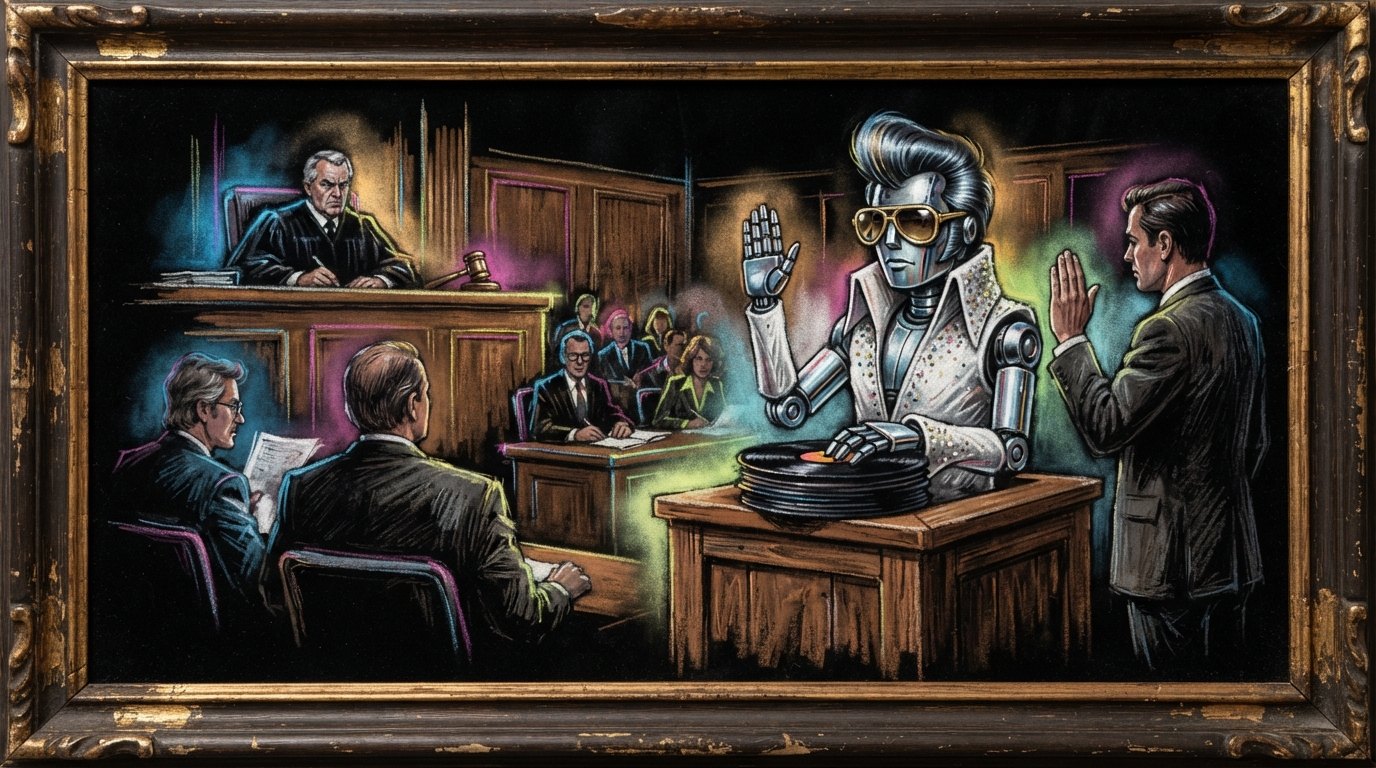
Illustration: Dispatch
Suno is fighting claims from nearly every corner of the music business at once. Elvis Presley's rights holders and Eminem's publisher sued on Nov. 6. A catalog owner, Reservoir, expanded its case on Nov. 11. Working musicians led by Jason Isbell are pressing a class action. And the labels' long-running case has reached Suno's investors.
The suits rest on different legal theories. Copyright is the common thread. Some add state laws that protect a person's voice and likeness; others add federal claims that Suno got around platform protections or stripped songwriter credits. Each new theory is another way to win if Suno's fair-use argument holds.
The Presley suit
Elvis Presley Enterprises is a lead plaintiff, suing in federal court in Northern California alongside ABG EPE IP, Raleigh Music Publishing, Abilene Music and other rights holders. Both EPE entities are controlled by Authentic Brands Group, which is not itself a named plaintiff.
EPE says Suno can turn out songs that imitate Presley's voice. It sues under Tennessee's ELVIS Act, the 2024 law on AI voice cloning, and under Tennessee common-law publicity rights, making the case an early test of the law that bears his name. The group lists 859 compositions and adds federal claims for copyright infringement, circumventing streaming and lyrics-site protections, and removing songwriter and publisher credits. Music Business Worldwide tallies the claims at just over $202 million before any tripling, and EPE asks the court to order copies removed from training data and model weights.
A Suno spokesperson told The Verge the company blocks prompts naming specific artists or songs and screens uploads. Suno hasn't yet responded in court.
Eminem is not a plaintiff. His publishers, Eight Mile Style and Martin Affiliated, filed a separate suit the same day in the same court (No. 3:26-cv-13399) over 269 songs, seeking about $47.7 million.
The investor front
On Nov. 10, Nvidia's venture arm, NVentures, asked a federal court in Northern California to quash or narrow UMG and Sony's demand for its testimony, calling itself a passive minority investor in Suno. Nvidia Corp. filed its own motion the same day against a separate deposition subpoena. The labels' responses are due Nov. 24.
Meanwhile, AI music courts respectability
The first U.S. AI Music Awards were held in downtown Los Angeles on Nov. 13. The top prizes went to Xania Monet, an AI-generated singer created by Telisha "Nikki" Jones. AI acts are winning awards and chart spots while the tools behind them face billions in theoretical claims.
What's next
| Date | What happens | Case |
|---|---|---|
| Nov. 20 | Extended deadline for some third-party depositions | UMG, Capitol, Sony v. Suno (Boston) |
| Nov. 24 | Labels respond to NVentures' and Nvidia's motions | Subpoena fight (N.D. Cal.) |
| Dec. 1 | Musicians respond to Suno's motion to dismiss | Isbell v. Suno (Boston) |
| Dec. 15 | Suno's reply | Isbell v. Suno (Boston) |
Sources: MBW; MBW (ELVIS Act); Copyright Now; MBW (NVentures); Law Commentary; Reuters via Yahoo.